
A helical wind turbine is a vertical-axis wind turbine (VAWT) with spiral-shaped blades that wrap around a central vertical shaft. It captures wind from any direction without yaw adjustment, delivers smoother torque than straight-bladed designs, and suits urban rooftops and distributed energy sites where conventional turbines face practical limits.
Executive Summary
- Helical wind turbines are a subtype of vertical-axis wind turbine (VAWT), distinguished by blades twisted in a continuous helix along a vertical rotational axis
- The helical blade geometry distributes aerodynamic torque more evenly across each rotation, reducing pulsation and mechanical vibration compared with straight-bladed Darrieus designs
- Residential-scale units are available for a few hundred dollars for the turbine unit alone; commercial installations with full electrical grid connection can reach into the millions
- Primary use cases include urban and suburban rooftop installations, locations with turbulent or multi-directional wind, cold-climate sites, and environments where wildlife sensitivity makes high-speed conventional turbines unsuitable
What Exactly Is a Helical Wind Turbine?
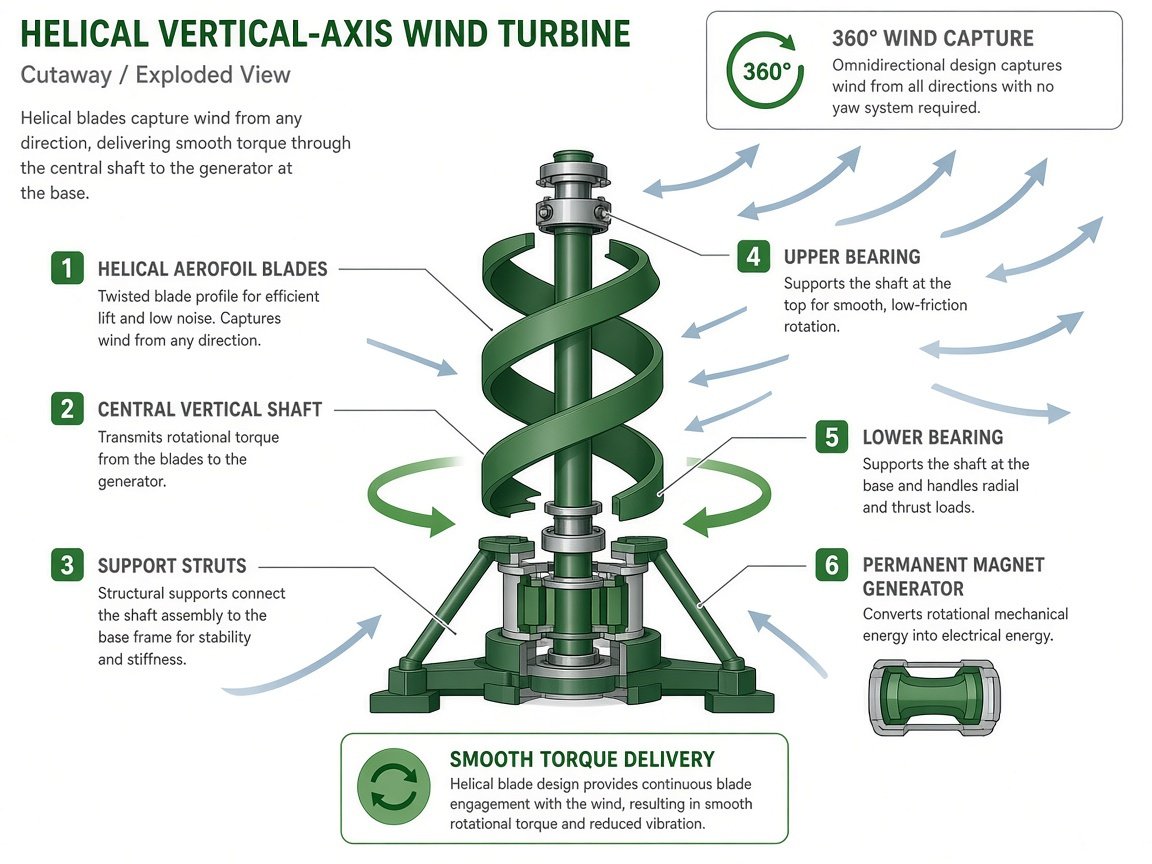
A helical wind turbine is a vertical-axis wind turbine whose rotor blades follow a continuous spiral, or helix, along the length of the central shaft. Where a conventional straight-bladed Darrieus turbine uses flat, vertically oriented aerofoil sections, the helical variant twists those blades through a defined arc from the base of the shaft to its top. The result is a geometry that is more mechanically complex to manufacture but aerodynamically more consistent in operation.
The concept was notably advanced by engineer Alexander Gorlov at Northeastern University. The Gorlov Helical Turbine received the ASME Thomas A. Edison Patent Award in 2001 in recognition of its contribution to energy technology. The engineering insight behind the helical form is that it ensures some portion of the blade surface is always at an aerodynamically productive angle of attack relative to the incoming wind. This eliminates the torque dead zones that occur in some straight-bladed Darrieus designs, where blades momentarily lose lift and produce no net force on the shaft.
The result is a turbine that starts more reliably at lower wind speeds and runs with less vibration throughout its operational cycle. For distributed generation in built environments — where turbulence, multi-directional airflow, and proximity to other structures are daily realities — these characteristics translate into meaningful practical advantages over both horizontal-axis turbines and earlier vertical-axis designs.
How Does a Helical Wind Turbine Generate Electricity?
The working principle follows the same chain as any wind turbine: moving air exerts a lift force on the aerofoil-shaped blades, creating rotational torque on the central shaft. That shaft drives a generator — typically a permanent magnet alternator in small and medium designs — which converts mechanical rotation into electrical current. An inverter then conditions the output to match the voltage and frequency of the connected load or grid. For off-grid applications, the turbine output charges a battery bank instead.
The helical blade geometry changes the aerodynamic profile of this process across the full rotation cycle. Because each blade is twisted along its length, different sections of that blade encounter their peak lift angle at slightly different times as the rotor turns. This spreads total torque over a longer arc and flattens the pulsation cycle. In a straight-bladed Darrieus turbine, the same aggregate lift can arrive in discrete pulses — introducing vibration into the drivetrain and foundation structure that places cyclic stress on mechanical components.
For small distributed installations — rooftop units, farm outbuildings, remote telecoms masts — this smoother power delivery matters in practice. Flatter torque reduces fatigue loading on bearings and structural connections, and it produces a cleaner electrical output that places less stress on downstream inverter electronics. Manufacturers of helical turbines cite this characteristic as contributing to their designs’ longevity and reduced maintenance intervals relative to straight-bladed alternatives of equivalent output.
How Does the Helical Design Differ From Other Vertical-Axis Turbines?
Vertical-axis wind turbines divide broadly into two aerodynamic families. Savonius turbines use scooped, drag-based rotors and are inherently self-starting but relatively inefficient at converting wind energy into electricity. Darrieus turbines — of which the helical design is a refined variant — use lift-based aerofoil blades and can achieve higher power coefficients, though earlier straight-bladed versions suffered from torque pulsation and start-up difficulties that required mechanical assistance or the addition of Savonius scoops to initiate rotation.
The helical turbine occupies a refined position within the Darrieus family. Its primary distinction from a straight-bladed Darrieus turbine is the continuous blade twist that eliminates most torque pulsation. It also differs from the H-type Darrieus — a common modern variant with straight blades held by horizontal struts at top and bottom of the shaft — in that the blades attach along the shaft in a continuous helix, reducing structural complexity while requiring more precision in blade manufacture.
Compared with horizontal-axis wind turbines (HAWTs), the helical turbine accepts wind from 360 degrees, needs no yaw mechanism, is shorter in profile, and operates at lower rotational tip speeds. The trade-off is lower peak efficiency: large HAWTs operating in open terrain typically outperform VAWTs in raw energy yield per rotor swept area, because their longer blades operate at higher tip-speed ratios where aerodynamic efficiency is greatest. The helical turbine is therefore not a replacement for large HAWTs in utility-scale generation, but a distinct tool suited to different site conditions.
| Feature | Helical VAWT | H-Darrieus VAWT | Savonius VAWT | Horizontal-Axis (HAWT) |
|---|---|---|---|---|
| Wind direction sensitivity | Omnidirectional — no yaw needed | Omnidirectional — no yaw needed | Omnidirectional — no yaw needed | Requires mechanical yaw tracking |
| Self-starting | Generally yes | Often requires assistance | Yes | Yes (above cut-in speed) |
| Torque smoothness | High — helix spreads torque evenly | Moderate — some pulsation | Low — high pulsation | Moderate (3-blade designs) |
| Noise profile | Low | Low–moderate | Moderate | Moderate–high at scale |
| Efficiency at scale | Moderate | Moderate | Low | High |
| Urban suitability | High | Moderate–high | Moderate | Low |
| Blade manufacturing complexity | High (twisted aerofoil) | Moderate (straight aerofoil) | Low (curved scoop) | High (tapered and twisted) |
| Typical scale | Micro to medium | Micro to large (research) | Micro to small | Micro to utility-scale |
What Are the Key Advantages of Helical Wind Turbines?
Omnidirectional wind capture is the most cited operational advantage. The vertical axis means the rotor produces torque regardless of which compass direction the wind arrives from. A horizontal-axis turbine must mechanically rotate its nacelle to track the wind; in rapidly shifting or turbulent urban airflow, the yaw mechanism can lag behind wind direction changes and lose harvestable energy in the process. The helical turbine requires no such adjustment, making it particularly productive in built environments where wind direction varies continuously and unpredictably.
Lower noise output is a connected benefit. Helical turbines run at comparatively low blade-tip speeds relative to large horizontal-axis machines. High-frequency aerodynamic noise — the characteristic rhythmic sound associated with large HAWT installations — scales with tip speed, so the slower-turning helical rotor produces less tonal noise. Manufacturer literature for small and medium helical turbines describes operating noise levels as comparable to typical ambient background noise in a residential setting, making neighbourhood and rooftop installations more socially and regulatorily acceptable.
Cold-climate performance is frequently highlighted in product specifications. Without large horizontal blade spans to accumulate ice unevenly, and with the entire rotor operating close to the central mass, helical turbines are described in manufacturer literature as less susceptible to ice-induced imbalance than horizontal-axis turbines, whose long horizontal blades can accumulate ice differentially and create dangerous vibration or structural failure risk. This makes the helical design an attractive option for high-latitude or mountainous installations where seasonal icing is a regular concern.
Structural resilience in high winds is another advantage identified in design literature. Because the blades are oriented parallel to the rotation axis rather than sweeping perpendicular to the wind stream in the manner of an HAWT, they present a different aerodynamic loading profile in a gust. Some helical designs also incorporate blade materials or geometries engineered to flex and partially shed excess aerodynamic load during storm conditions, reducing peak structural stress on the foundation and tower.
What Are the Limitations You Should Know Before Buying?
⚠ Site Assessment Is Non-Negotiable
No turbine technology performs well on a poor wind resource. A professional site wind assessment should precede any purchase decision. Installing without one risks a system that never recovers its capital cost.
Lower peak power density compared with large HAWTs is the most significant engineering constraint. The vertical-axis design inherently limits the swept area available to rotor blades at a given total rotor diameter. For utility-scale power generation on open plains or offshore, horizontal-axis turbines remain the dominant choice for this reason, and no current helical design changes this fundamental geometry. Buyers expecting utility-scale output from a compact rotor will be disappointed.
Noise and vibration, while lower than a large HAWT, are still present and require consideration in dense urban settings. Direct rooftop mounting can transmit turbine vibration into building structure, and additional isolation hardware — spring mounts, damping pads — may add to installation cost and complexity. The building structure itself must be assessed by a structural engineer to confirm it can bear both the static weight and the dynamic cyclic loads the turbine produces over its operational lifetime.
Permitting complexity varies widely by jurisdiction. In many countries, any turbine mounted on a structure above a specified height, or generating above a threshold output, requires planning or building permits. Installation in conservation areas, near listed buildings, or within controlled airspace near airports typically involves additional scrutiny and may be refused. These requirements should be confirmed with the relevant local authority before equipment is purchased, as they can significantly affect project viability.
Cut-in speed — the minimum wind speed needed to begin generation — is a practical constraint for low-wind sites. While the helical blade geometry produces torque more consistently than some straight-bladed designs, every turbine still has a threshold below which no usable power is generated. Sites with low annual average wind speeds will see extended periods of zero generation, and overall annual yield may be significantly below projections if the site wind resource has not been properly measured before selection.
When Is a Helical Wind Turbine the Right Choice?
The helical turbine is best matched to specific site and use-case profiles rather than deployed as a universal solution. The following situations represent the strongest practical fit.
Urban and suburban environments. Buildings channel and redirect airflow in complex, shifting patterns that change with wind direction, speed, and the interaction of nearby structures. A turbine that harvests energy from multiple wind directions without yaw adjustment is better adapted to this environment than one that must track a single prevailing direction. Where noise constraints, visual impact restrictions, and limited mounting space are factors — as they typically are in populated areas — the helical turbine’s compact, quieter profile is a genuine advantage.
Rooftop installations. Many commercial and industrial buildings have flat or low-pitch roofs with structural capacity to support a small turbine. Helical turbines do not require the tall mast heights demanded by HAWTs to reach unobstructed wind. Some purpose-built designs are engineered specifically for parapet-mount or rooftop-pedestal installation, with pre-engineered structural bases and vibration isolation systems designed to meet building regulations. As an illustrative scenario: a commercial warehouse with an exposed rooftop in a coastal town, where wind arrives from multiple directions depending on weather system, represents the type of site where the helical turbine’s omnidirectional capture and compact footprint work together to maximise generation potential.
Remote and off-grid sites. Small helical turbines paired with battery storage work well where grid connection is impractical or expensive. A remote telecommunications installation, agricultural building, or off-grid dwelling can use a helical turbine to supplement solar photovoltaic generation and reduce diesel consumption — particularly during winter periods of low solar irradiance when wind energy tends to be more available.
Cold and icing-prone climates. Where ice accumulation is a seasonal risk, the helical turbine’s compact, vertically balanced rotor is noted in product literature as being more tolerant of partial icing than a horizontal rotor that depends on precise blade balance for safe operation at speed. This makes it a practical consideration for Scandinavian, Canadian, or high-altitude alpine installations where horizontal-axis turbines may require costly de-icing systems or operational shutdowns.
How Much Does a Helical Wind Turbine Cost?
Cost varies considerably by output capacity, build quality, country of manufacture, and whether installation, electrical work, and grid connection are included in the quoted price. As a general orientation, helical turbines are typically priced at a premium relative to horizontal-axis turbines of equivalent rated output, reflecting the greater manufacturing complexity of the twisted aerofoil blade geometry.
At the residential small-scale end — units rated at a few hundred watts, intended for supplemental power to a home, garden office, or small workshop — entry-level turbine units begin at a few hundred dollars for the turbine hardware alone. These are typically direct-drive permanent-magnet alternators with simple charge-controller electronics and minimal third-party certification. Buyers at this price point should scrutinise build quality carefully, as manufacturing consistency varies widely among low-cost suppliers.
Stepping up to a mid-range unit rated at one to ten kilowatts, designed for meaningful contribution to a home or small business electricity demand, costs rise sharply. Equipment cost alone typically runs into the thousands of dollars, and installation — including foundation or structural mount preparation, cabling, inverter, and connection to the building’s electrical system — adds substantially to the total outlay. Professional installation by qualified electricians and structural engineers is advisable at this scale, and those fees should be factored into the budget from the outset.
At commercial scale — turbines rated at tens to hundreds of kilowatts, with professional structural engineering, foundations, grid connection agreements, and regulatory compliance work — total installed costs can reach upwards of one million dollars. This reflects not just the equipment but the considerable civil, electrical, and permitting work that large commercial installations require. A professional financial appraisal alongside a wind resource assessment is essential before committing capital at this scale.
Cost Context
Being less common in the market than standard horizontal-axis wind turbines, helical turbines carry a manufacturing cost premium per kilowatt of rated output. This premium can be justified by specific site and application advantages described in this article, but it reinforces the importance of matching turbine type to actual site conditions through a thorough wind resource assessment before purchase.
How Do You Install a Helical Wind Turbine Step by Step?
Installation complexity scales with turbine size, but the general sequence is consistent across most designs. The following process reflects the approach described in manufacturer documentation for ground-mounted and rooftop-mounted units, supplemented by standard civil and electrical engineering practice applicable across most jurisdictions.
- Site assessment. Measure the local wind speed and direction profile using an anemometer or a commercial wind mapping service, over a period long enough to capture seasonal variation. Confirm the site has adequate wind resource for the chosen turbine’s cut-in and rated wind speeds. Identify structural constraints, shading from nearby buildings or vegetation, and minimum legal setback requirements.
- Permitting and approvals. Submit applications for any required planning permission, building permit, and grid connection agreement from the local electricity distributor. This step can take weeks to several months depending on jurisdiction and should begin before any equipment is purchased to avoid costly delays.
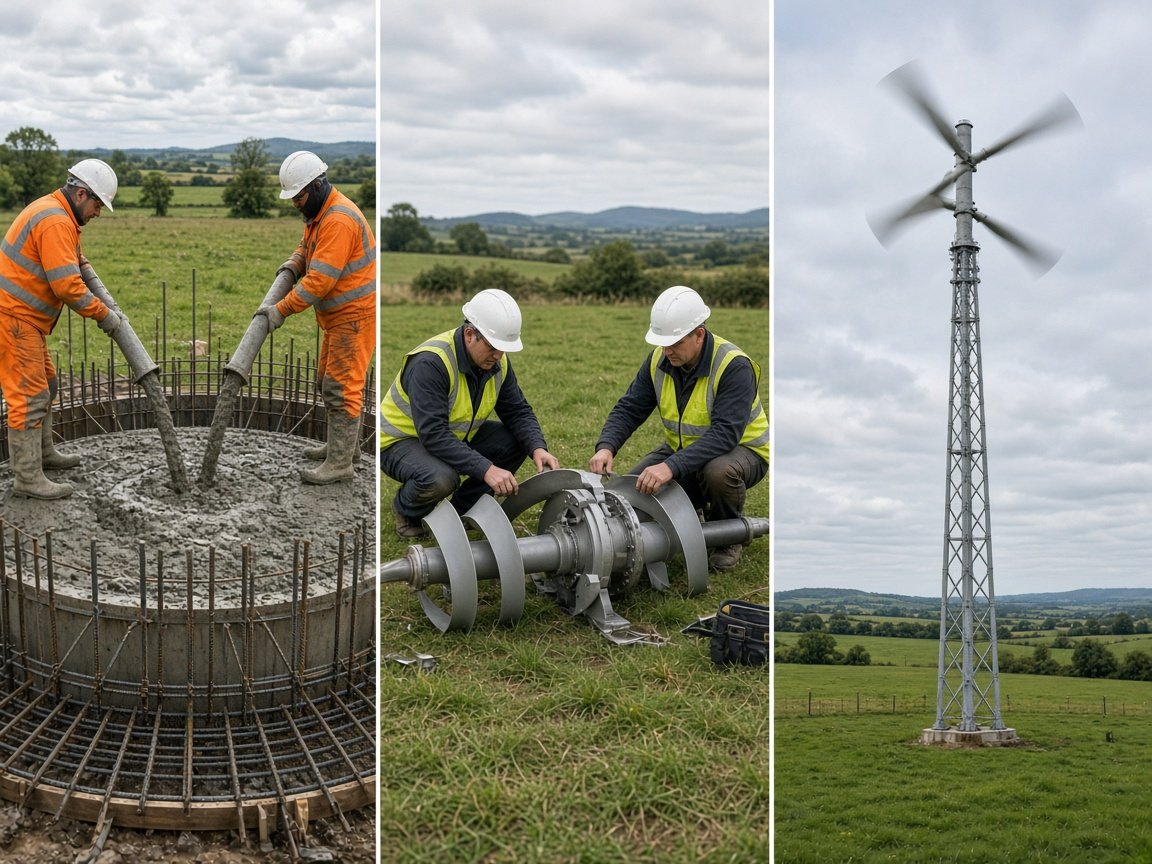
- Foundation preparation. For ground-mounted turbines, excavate to the depth specified in the structural engineering drawings and pour a reinforced concrete foundation. Allow full cure time per the structural specification before applying load — this is typically a minimum of 28 days for concrete to reach full design strength under standard conditions.
- Turbine assembly. Assemble the rotor blades, central shaft, bearing housings, and generator according to the manufacturer’s documentation and in the specified sequence. For small turbines this is typically a two-person job without specialist lifting equipment. Larger turbines may require a small crane or telehandler, as noted in the manufacturer’s installation guide.
- Mast or structural mounting. For pole-mounted installations, bolt the assembly to the prepared foundation mast. For rooftop mounting, attach the structural base frame to the building at approved anchor points with vibration isolation hardware as specified. Confirm all fixings comply with the structural engineer’s specification and applicable building regulations.
- Electrical wiring. Run conduit and cabling from the generator to the charge controller or grid-tied inverter. Connect the DC or AC output to the building’s main distribution board or battery bank, following the wiring regulations applicable to your jurisdiction. All electrical work should be carried out by or supervised by a qualified electrician.
- Grid connection (where applicable). Work with the local utility or distribution network operator to complete the physical connection, install any required metering equipment, and commission the export protection relay. This relay prevents the turbine from energising the grid during a network power outage — a safety requirement in virtually all jurisdictions.
- Commissioning and testing. Verify that all safety cutouts, over-speed protection, and monitoring systems function correctly before beginning normal operation. Record baseline performance data against the manufacturer’s power curve to establish a reference point for ongoing monitoring and maintenance planning.
What Does Ongoing Maintenance Involve?
Helical wind turbines are described in manufacturer literature as lower-maintenance than horizontal-axis turbines of equivalent output, primarily because they have fewer moving parts at height. There is no yaw mechanism to service, no pitch actuation system, and no gearbox on most small and medium direct-drive designs. The generator is typically located at or near ground level on tower-mounted configurations, simplifying access considerably compared with the nacelle-mounted generator of a conventional HAWT.
Maintenance tasks fall into two categories: visual inspection and mechanical servicing. Visual inspection is recommended at least annually and after any severe weather event. This involves walking the perimeter to check blades for surface damage, cracks, or debris accumulation; examining all visible fasteners, structural connections, and cable entry points for corrosion or loosening; and observing the rotor during operation for any visible wobble, which could indicate a bearing issue or blade imbalance developing.
Mechanical servicing intervals are specified per manufacturer, typically every one to three years. Standard tasks include lubricating main shaft bearings to the specified grease type and quantity; inspecting the generator for brush wear if the design uses slip rings; inspecting and cleaning electrical terminals and connections; testing the charge controller, inverter, and all safety shutdowns; and replacing wear items — seals, brushes, filters — per schedule. Blade hygiene deserves particular attention: debris, contamination, or moss on the blade surface disrupts the aerofoil profile and reduces aerodynamic efficiency. Periodic washing with water and a soft brush is typically sufficient. With scheduled maintenance, most helical turbine designs are rated by manufacturers for operational lifespans measured in decades.
How Do Helical Turbines Compare on Wildlife and Environmental Impact?
Environmental impact is an important consideration for any wind energy technology, and helical turbines compare favourably with large horizontal-axis wind turbines on several dimensions relevant to wildlife and community acceptance.
Bird and bat collision risk. The primary wildlife concern for large HAWTs is blade strike on birds and bats, which are attracted to insects and thermal updrafts around tall structures. Helical turbines rotate much more slowly and at a lower height profile. The blade motion is more visible to wildlife at these lower tip speeds, giving birds more time to perceive and avoid the rotor. This does not eliminate collision risk entirely, but the design characteristics of small and medium helical turbines are widely recognised in the industry as presenting a lower risk profile than a large HAWT spinning at high tip-speed ratios. Manufacturer literature for many helical turbine models explicitly highlights this characteristic.
Land use. Ground-mounted helical turbines in commercial arrays require access roads, electrical infrastructure, and setback distances, contributing to land use impacts broadly similar to other commercial wind developments. Rooftop installations have essentially no incremental land use impact, which is one reason urban building-integrated wind is an area of active development interest.
Materials and end of life. Like all wind turbines, helical turbines use composite materials for blades that are not easily recycled at end of life. The industry across both VAWT and HAWT sectors is actively working on recyclable blade materials, including thermoplastic and bio-resin composites, but this remains an ongoing engineering and policy challenge. Prospective buyers should ask manufacturers about their end-of-life blade take-back or disposal arrangements.
What Does the Near-Term Future Hold for Helical Wind Technology?
The period following 2026 is likely to bring several notable developments in helical and vertical-axis wind turbine technology, driven by growing interest in distributed urban generation and improvements in materials engineering.
Urban integration and building-integrated wind is a growing design discipline. Architects and developers in several European and Asian cities have incorporated helical turbines into the structural design of new commercial buildings — positioning rotors in architectural gaps where channelled airflow creates effective wind resource without occupying usable floor space. As net-zero building codes become more prevalent, this approach is expected to gain traction in new commercial and mixed-use developments.
Advanced composite materials are reducing blade weight while improving fatigue resistance. Research programmes at several universities are exploring bio-based resins and thermoplastic composite matrices specifically for small and medium VAWT blade applications. Thermoplastic composites in particular offer the prospect of recyclable blade construction, addressing the end-of-life waste challenge that currently applies to both VAWT and HAWT composite blades.
Smart monitoring and digital integration. IoT sensors and remote monitoring platforms are becoming standard features on mid-range turbine products. This allows real-time performance tracking, predictive maintenance alerts, and automated generation reporting — lowering the ongoing management burden for distributed installations and enabling better performance benchmarking against predicted output from the site wind model.
Floating offshore VAWT research is gaining momentum. Some research programmes are investigating helical and other vertical-axis turbines on floating platforms for deep offshore waters, where the VAWT’s lower centre of gravity and bidirectional wind response may offer structural advantages over floating HAWTs in certain sea states. These concepts remain at research and demonstrator stage as of 2026, but they represent an emerging application pathway that could significantly expand the addressable market for helical turbine technology in the medium term.
Frequently Asked Questions About Helical Wind Turbines
What is the difference between a helical turbine and a Darrieus turbine?
A Darrieus turbine is the broader turbine family — it uses aerofoil-shaped lift blades rotating on a vertical axis. A helical turbine is a specific variant of the Darrieus design in which the blades are twisted in a continuous spiral rather than running straight up the shaft. The twist distributes aerodynamic torque more evenly across each rotation and reduces mechanical vibration, while also improving self-starting behaviour at lower wind speeds.
Can a helical wind turbine power an entire house?
A small residential helical turbine at a few hundred watts of rated output will supplement a household’s electricity supply, not replace it. A well-sited turbine rated at several kilowatts in a genuinely windy location could cover a meaningful fraction of average household consumption, depending on local wind speed, household demand profile, and whether battery storage is included. Full household energy independence from wind alone is unusual except at very high-wind sites with generous installed capacity.
Are helical wind turbines suitable for rooftop installation?
Yes — they are among the turbine types most commonly proposed for rooftop use. Their compact profile, lower noise output, and 360-degree wind capture make them better adapted to rooftop conditions than horizontal-axis turbines. However, rooftop installation still requires a structural assessment of the building, planning permission in most jurisdictions, and careful isolation of turbine vibration from the building fabric to prevent noise transmission into occupied spaces.
Do helical wind turbines work in low wind speeds?
Every turbine design has a cut-in wind speed below which it generates no usable power. The helical blade geometry produces torque more consistently across the rotation cycle than some straight-bladed designs, often allowing a lower cut-in speed. However, meaningful electricity generation still requires adequate average wind speed at the site. Sites with predominantly light winds will produce limited annual energy yield from any turbine type, regardless of design.
How long does a helical wind turbine last?
Manufacturer-specified design lifetimes for quality commercial helical turbines are typically stated at 20 years or more, subject to routine maintenance schedules being followed. Bearing replacement is the most common scheduled servicing requirement, with intervals specified per manufacturer. Blade integrity over long periods depends on material quality, UV exposure, salt spray, and any mechanical impacts during operation.
Are helical wind turbines quieter than conventional wind turbines?
In general, yes. The lower blade-tip speed characteristic of helical and other vertical-axis turbines produces less high-frequency aerodynamic noise than a large horizontal-axis turbine. At close range, some mechanical noise from the generator and bearings may be audible during operation, but most small and medium helical turbines are described in product literature as operating at sound levels comparable to background ambient noise in a residential area.
What permits are needed to install a helical wind turbine?
Permit requirements depend on jurisdiction, turbine size, mounting location, and proximity to buildings, heritage sites, or flight paths. Common requirements include planning permission or permitted development approval, building regulations sign-off for structural modifications, electrical installation certification to the applicable national standard, and a grid connection agreement with the local distributor network operator. Consult the relevant local authority and your electricity network operator before purchase — not after.
What Are the Next Steps If You Are Considering a Helical Wind Turbine?
A helical wind turbine is a technically sound choice for a well-defined set of applications — particularly urban and suburban distributed generation, rooftop installations, cold climates, wildlife-sensitive sites, and off-grid supplemental power. It is not a universal replacement for horizontal-axis turbines in open, high-wind terrain, where larger HAWTs retain a substantial efficiency advantage that the helical design cannot overcome.
If you are evaluating a helical turbine for your property or project, the following sequence provides a practical implementation path:
- Conduct a wind resource assessment — either by deploying an anemometer for three to six months or using a commercial wind mapping service — to establish whether your site has adequate wind speed and consistency to justify installation costs.
- Identify the right turbine capacity for your load profile and generation target, using the site wind data against the manufacturer’s published power curve for each shortlisted model.
- Start the permitting process early. Planning and grid connection approvals can take months. Beginning before equipment purchase avoids costly delays and ensures you can proceed when the equipment arrives.
- Obtain competitive quotations that include installation, electrical work, vibration isolation hardware, commissioning, and an ongoing maintenance contract from approved installers.
- Commission with monitoring in place so you can verify actual performance against the projected output from the outset, and identify any underperformance before warranty periods expire.
The team at Ecologic Power can provide guidance on turbine selection and site suitability tailored to your specific requirements. Use the contact or comments section on this page to get in touch, or browse the small helical turbine range available through the site for residential and light commercial applications.
“`